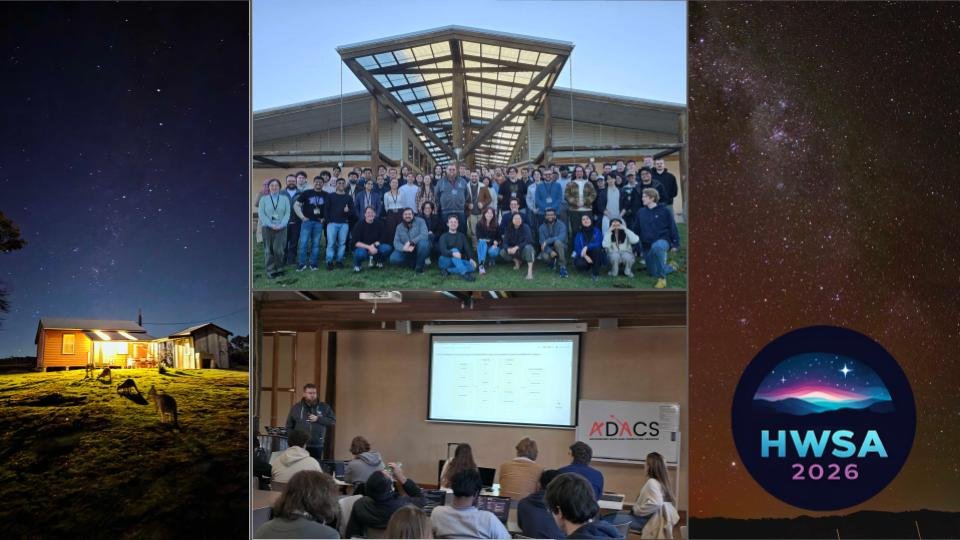
The 2026 Harley Wood School for Astronomy (HWSA) was held at the ANU coastal campus in Kioloa NSW, with the theme of "Bridging Observation and Theory in the Age of Big Data Astronomy".
The ADACS team of Paul and Joel delivered a two part workshop where people learned why big data matters and how it breaks their typical research workflows. The main focus of the workshop, however, was on these workflows and how they benefit everyone involved in a research project. The idea of reproducible, or at least re-runable, research workflows was used to motivate many of the activities. The workshops were 3 hours in total, with around 50% of the time spent on interactive activities. Students were highly engaged in these workshop activities. In fact most of the feedback being people asking for even more time to spend on these activities.
As well as delivering the workshop, Paul and Joel participated in the remainder of the HWSA school, providing many opportunities for students to continue their engagement in the content, but also to better understand the role of ADACS, as well as having an opportunity to discuss data and computing questions specific to their research projects.
The workshop was delivered in the style of a software carpentries lesson and the website is available for anyone wishing to engage in the content in a self paced manner. Running your own version of the workshop based on the material is highly encouraged, and if you would like to have this or a modified version delivered again by ADACS please get in touch.
Workshop website: https://adacs-australia.github.io/2026-HWSA-Workshops/index.html
Check out some of our other training projects.
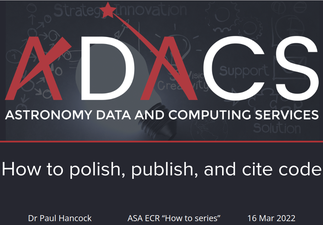
The ASA Early Career Researcher (ECR) Chapter Steering Committee organised a virtual "How To" series, answering some of the most pressing questions from our community.
A four-part ML (machine learning) workshop consisting of a lecture on the history of ML and it's applications in astronomy research and three deep-dive sessions to apply ML techniques to astronomy data sets.
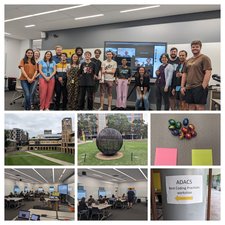
A three day workshop aimed at researchers without formal coding/software development training and designed to give people a taste of many different aspects of best practices in scientific computing.